
DJI Dock 3
by DJIEquipped with Matrice 4D or Matrice 4TD high-performance drones, DJI Dock 3 empowers 24/7 remote operations and, for the first time, supports mobile vehicle-mounted deployment, effortlessly adapting to various environments.
- Installment Payment You can pay in installments using Visa, Visa Premium, Maestro, MasterCard, Diners credit cards. The fee is 5% over the quoted price, and it is assigned to your purchase order in your shopping cart upon the selection of the methods of payment. For more details, please click on the link containing The Methods of Payment.
- Fast Delivery For all the purchase orders within Croatia received by 02:00 p.m. on a working day, delivery will be made on the following working day*. On the territory of Europe, we provide a fast delivery service. For more details, please click on the link containing The Delivery Terms.
- International Purchasing The companies within the EU (except for the Republic of Croatia) with a valid VAT ID number, will pay the price exclusive of VAT. The price will be calculated upon checkout. All the customers outside of the EU will pay the export price exclusive of VAT.

Package includes
- DJI Dock 3 (Overseas Edition)
Equipped with Matrice 4D or Matrice 4TD high-performance drones, DJI Dock 3 empowers 24/7 remote operations and, for the first time, supports mobile vehicle-mounted deployment, effortlessly adapting to various environments. The drones utilize the same cameras as the Matrice 4 Series but offer improved flight and protection performance. They can also pair with DJI RC Plus 2 Enterprise for standalone use. With DJI FlightHub 2's intelligent features, pilots can significantly cut down on operational time and labor costs, maximizing efficiency and savings.
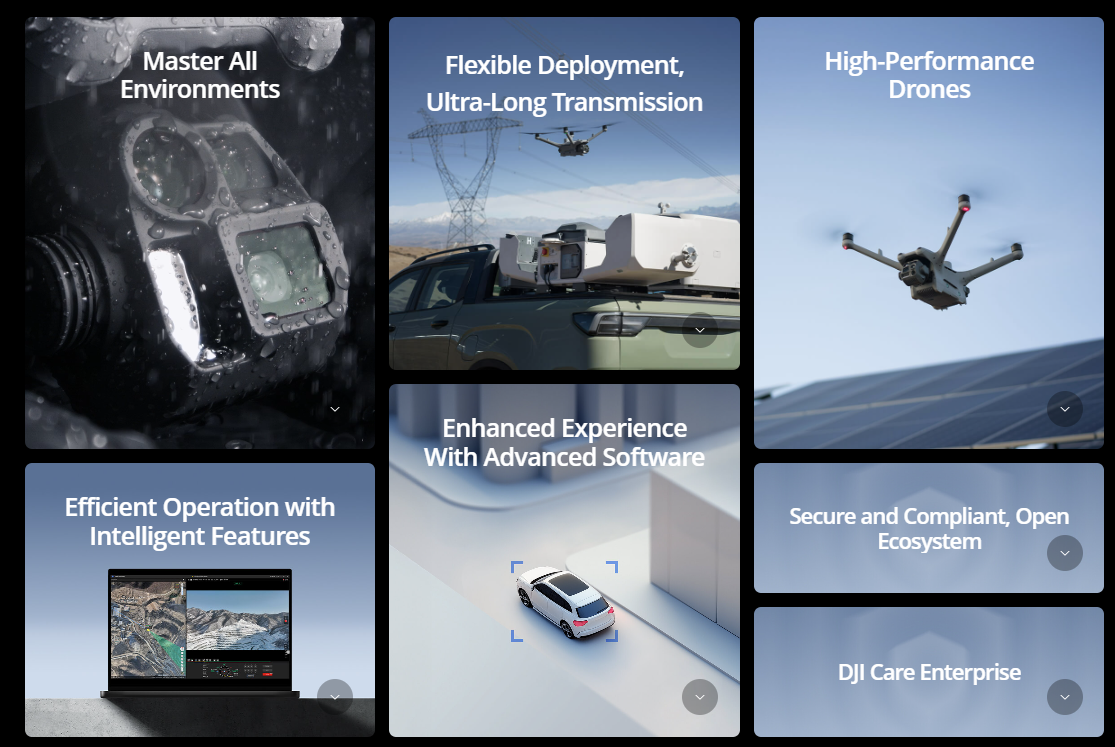
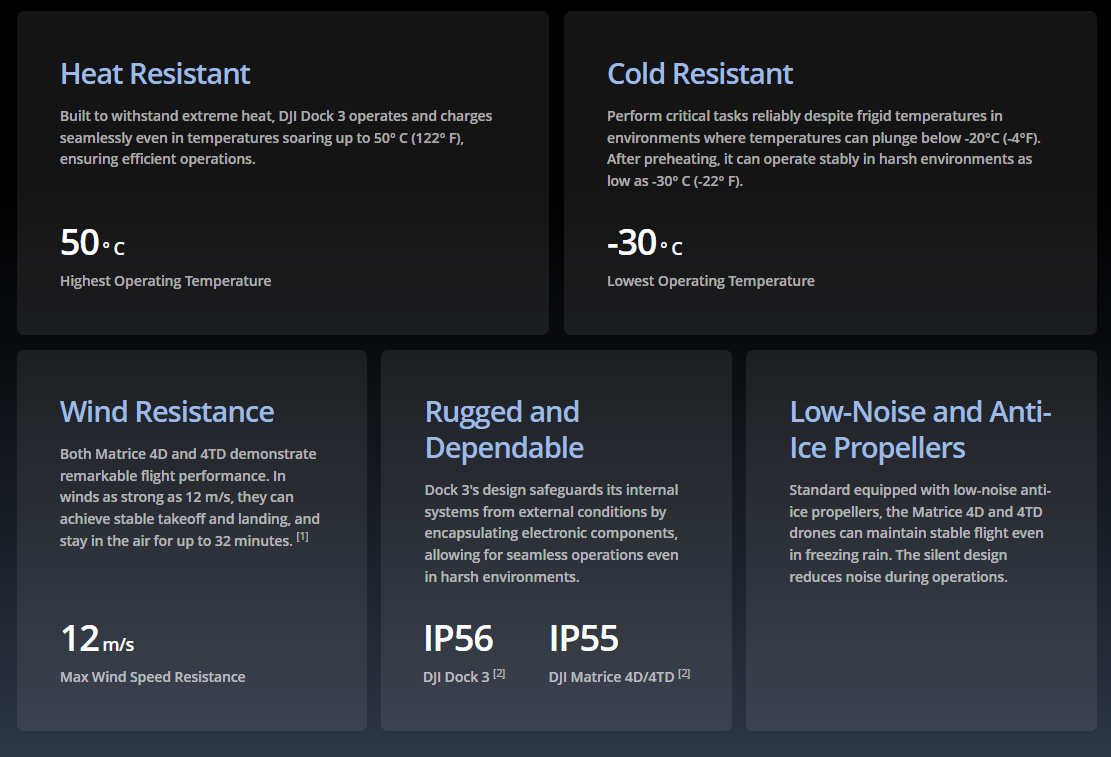
Adaptability - Master All Environments
Deployments - Flexible Deployment, Ultra-Long Transmission
DJI Dock 3 can be flexibly deployed, redefining the paradigm of operations. For fixed deployments, signal quality can be enhanced by installing the next-gen D-RTK 3 Relay at elevated locations, allowing for flexible site selection of the dock. With the new DJI Enterprise app, deployment can be completed using just a smartphone. [3] Additionally, for the first time, a DJI Dock supports vehicle-mounted deployment, enabling more efficient dispatch during urgent operations and long-distance inspections.
Fixed-Mounted Deployment
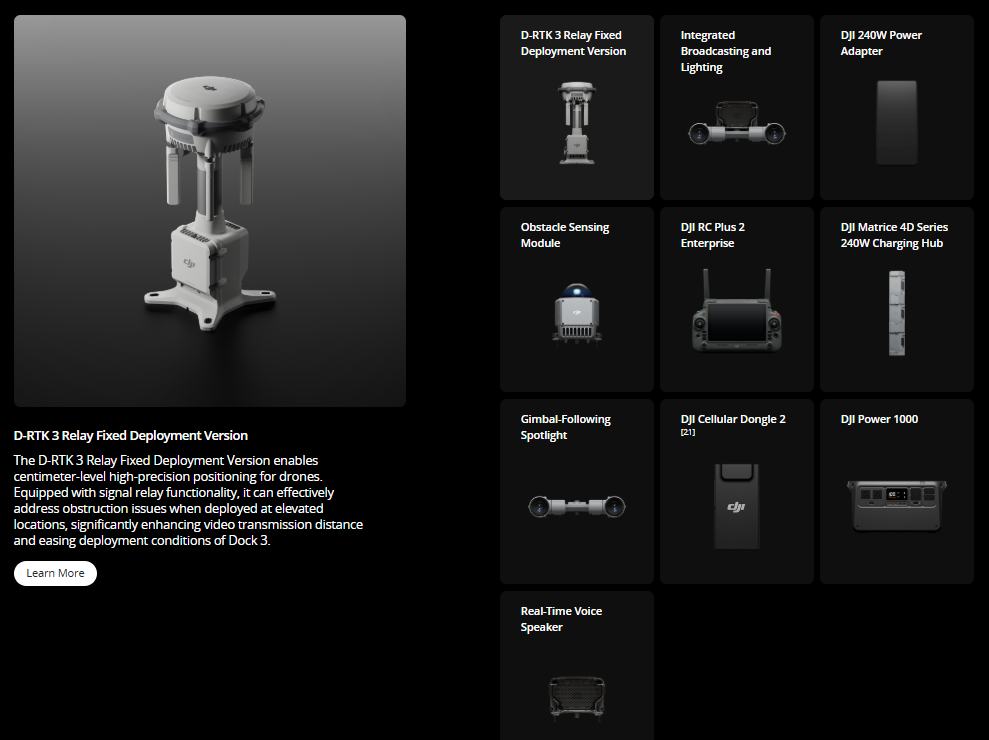
The new D-RTK 3 Relay Fixed Deployment Version [4] offers superior anti-interference performance for video transmission and satellite acquisition. Installing it at elevated locations can effectively address RTK and video transmission signal issues caused by obstructions, extending the maximum transmission distance to 25 km. This capability allows for flexible site selection of Dock 3 based on actual operational needs.
Near High-Rise Buildings [30]
Installing the D-RTK 3 Relay on rooftops can significantly enhance signal quality, allowing Dock 3 to be deployed next to high-rise buildings or substation walls.
Near Communication Towers [5][30]
Deploying the D-RTK 3 Relay on a nearby communication tower can significantly enhance signal quality during Dock 3 operations, ensuring safe takeoffs and landings even in environments with interferences from the communication tower.
Mobile Vehicle-Mounted Deployment
DJI Dock 3 is DJI's first Dock to support mobile vehicle-mounted deployment. [6] Optimized for this purpose, the Dock's overall structure, components, and air conditioning have undergone vehicle vibration testing, with new features such as horizontal calibration and cloud-based dock location calibration. For emergency operations or long-distance inspections, using DJI Dock 3 Vehicle-Mounted Gimbal Mount [4] for mobile deployment provides a convenient solution when fixed deployment is impractical in temporary scenarios.
Cloud-Based Dock Location Calibration
During mobile operations, indoor personnel can use DJI FlightHub 2 to remotely set the dock's location and assign tasks on the cloud, thereby enhancing personnel and scheduling efficiency.
Safe Dual-Dock Deployment
Two docks can be deployed on a single vehicle simultaneously, achieving a significant efficiency boost. DJI Dock 3 employs a special take-over pattern to avoid drone-to-drone collisions and ensure operational safety, allowing the two docks to alternate tasks in an orderly manner.
Dual-Drone Rotation [5]
Automated hovering rotation of two drones enables continuous real-time aerial footage transmission. In emergency scenarios, a spotlight can be equipped to provide full-time illumination.
Drones - High-Performance Drones
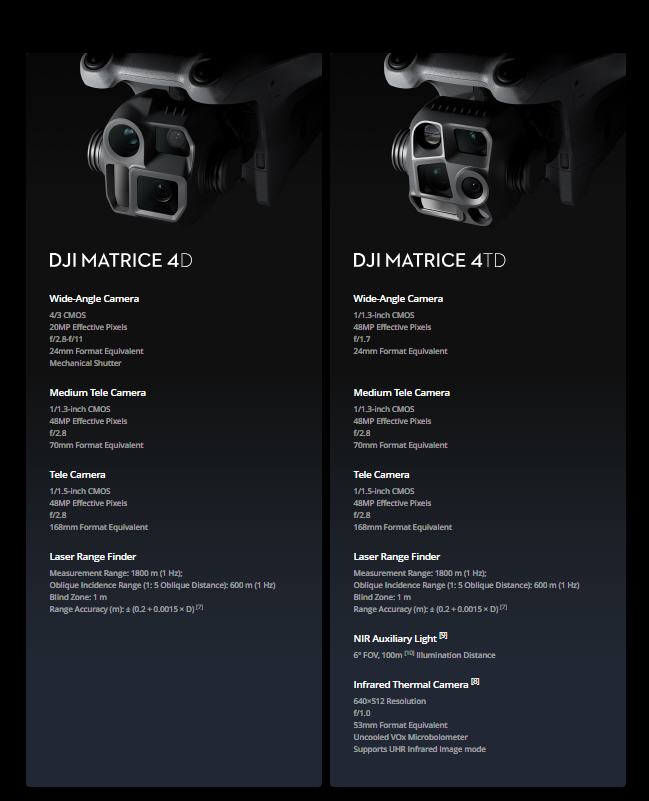
The all-new water and dust-resistant DJI Matrice 4D and 4TD are specifically designed for DJI Dock 3, offering extended flight time, and can pair with DJI RC Plus 2 Enterprise for standalone use. Both drones are equipped with a wide-angle camera, a medium tele camera, a tele camera and a Laser Range Finder. Matrice 4D is highly effective for professional high-precision mapping and detailed surface inspections. Matrice 4TD is equipped with an infrared thermal camera and a new NIR auxiliary light, making it suitable for a wide range of applications such as infrastructure inspections, emergency response, and public safety.
Longer Flight Time, Robust Protection
When fully charged, Matrice 4D/4TD delivers an impressive flight time of 47 minutes at a speed of 15 m/s, achieving a remarkable 37% increase in operation time. [11] At a radius of 10 km, these drones provide 18 minutes of operation. [12] Both models are designed to endure harsh conditions with an impressive IP55 dust and water resistance rating.
Obstacle Sensing for Safe Operation
The Obstacle Sensing Module [4] for Matrice 4D/4TD combines rotating LiDAR and millimeter-wave radar technologies for precise 12mm wire-level obstacle avoidance at speeds up to 15 m/s in complex power line crossings, as well as enhanced positioning in low-light conditions. [5] Operational safety are ensured for varying environments of power distribution network and the intricate layouts of substations.[15]
Unmatched Clarity and Precision for Any Task, Anytime
Excels in Low-Light Environments
Matrice 4D Series drones feature four high-resolution, low-light fisheye lenses, significantly enhancing [11] visual low-light positioning and obstacle sensing capabilities.
The new Night Scene mode offers full-color night vision. Matrice 4TD additionally provides IR-Cut Filter feature for black-and-white night vision and 24/7 operations, as well as a new NIR auxiliary light that can cover distances up to 100 m. [10]
Matrice 4TD's infrared thermal camera supports the UHR Infrared Image mode with image resolutions up to 1280 × 1024 and a High-Res mode for detailed temperature readings.
Clear Vision and Stable Images
Matrice 4D Series drones are equipped with medium tele and tele cameras with foreground stabilization. The medium tele camera is effective for medium-range inspections, detecting pins and cracks from 10 meters, and clearly reading instrument data at substations. [16]
The 48 MP tele camera captures details, like signs, from up to 250 m away. [17] When using Matrice 4TD's tele camera as the aircraft is hovering in a windless environment, the gimbal can tilt upwards by 80 degrees, making bridge underside defects clearly visible.
Upgraded stabilization keeps foreground subjects clear during telephoto shots at 10x zoom or higher.
High-Precision Surveying
Matrice 4D Series drones excel in high-precision mapping, offering a new 5-direction oblique photography function, 3-direction orthophoto photography, [5][18], and real-time terrain following to meet various mapping requirements.
DJI FlightHub 2 has been upgraded for Matrice 4D/4TD operations. This upgrade introduces a range of flight route planning options, including Smart 3D Capture routes [5], geometric routes, and slope routes, enhancing efficiency while ensuring detailed modeling.
Seamless Airborne Relay for Mountainous Terrains
Matrice 4D Series can operate with the DJI RC Plus 2 Enterprise remote controller for standalone use while featuring an innovative onboard relay function. With this setup, one drone can fly high as a relay, allowing another drone to operate at a greater distance. The relay drone automatically faces the operating drone, [5] ensuring smooth video transmission without a 4G signal or in obstructed conditions. [19] This capability significantly extends the transmission range, making it ideal for SAR tasks and inspections in mountainous areas.
FlightHub 2 - DJI FlightHub 2 Intelligent Features
When paired with DJI FlightHub 2, Dock 3 greatly enhances the intelligence and efficiency of remote operations.
Automated Routes
The new automated flight route is useful across various scenarios, including public safety and inspections. Once a flight route is established, the drone can automatically detect and capture images or videos of subjects like vehicles and vessels and infrared temperature anomalies, and send notifications to the operators.
Intelligent Change Detection
The new intelligent change detection feature enables efficient periodical analysis of changes in an area, assisting operators in environmental protection, natural disaster relief and crack detection for more effective and informed decision making.
Smart Track
Operators can utilize the powerful auto-zoom capabilities of the Matrice 4D Series to quickly track a subject, such as a vehicle or a vessel for efficient follow-up review.
Virtual Cockpit
The Virtual Cockpit remote control interface has been significantly enhanced with the introduction of the new Mouselook feature. This enhancement allows the drone to adjusts its attitude and gimbal orientation automatically, enabling rapid and precise centering of the frame, thus achieving "point and see."
Efficient Operation
Open and Fly
Take off quickly and arrive at the emergency site to improve situational awareness. After enabling optimal route planning, use FlyTo Tasks to reach a designated point 1 km away and at 100m height within 100 seconds. [12]
Low-Latency Live View
Engine upgrade significantly reduces [11] live view latency on FlightHub 2, providing reliable support for real-time decision-making.
Transmit While Flying
In emergency scenarios, real-time data transmission and rapid modeling can be achieved during flight. Data transfer can be completed immediately upon landing, [20]and a rough model can be quickly generated via the cloud, significantly enhancing efficiency.
Security - Security Compliance
FlightHub 2 Custom Permission Management
FlightHub 2 has upgraded its permission management, allowing users to configure management permissions according to actual needs.
FightHub 2 Achieves ISO 27001 Certification
FlightHub 2 uploads, stores and manages data on Amazon Web Services (AWS) cloud servers, which are also ISO/IEC 27001 certified, ensuring secure and compliant data processing.
4G Dongle Private Deployment
With DJI Cellular Dongle 2 [21], the aircraft can connect to 4G networks. In complex operational environments, the 4G network works in tandem with O4+ video transmission system to ensure a stable transmission and enhance flight safety. 4G enhanced video transmission service can be privately deployed and used in conjunction with the FlightHub 2 on-premises version to further enhance the stability and security of data transmission.
Open Ecosystem, Breaking Boundaries
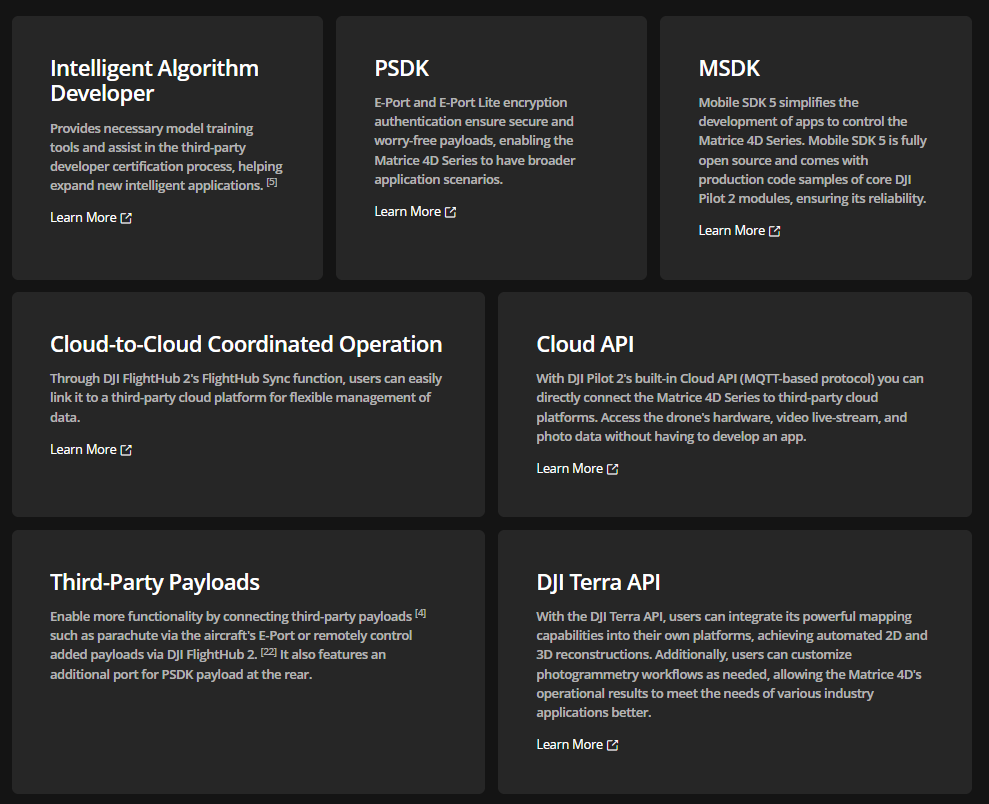
Accessories - Comprehensive Accessory Upgrades [23]
* All data on this page was collected using a production model DJI Dock 3 and DJI Matrice 4D/4TD in a controlled environment. Actual results may vary depending on the environment, usage, and firmware version.
** All videos and photos on this page were taken in strict compliance with local laws and regulations. Demos are for reference only. Please observe local laws and regulations and ensure that the aircraft has obtained relevant certifications before flying.
*** DJI Matrice 4D/4TD must be activated via the DJI Pilot 2 app or the DJI Enterprise app before use.
**** To ensure that the equipment operates steadily and continuously, please perform regular maintenance.
1. Measured when using a new battery with at least 95% battery at takeoff and at least 15% battery at landing. The data is for reference only. Always pay attention to reminders in FlightHub 2 or the DJI Pilot 2 app during flight.
2. DJI Dock 3 is IP56 rated, and the DJI Matrice 4D/4TD is IP55 rated. Both were tested under controlled laboratory conditions, with the dock's distribution cabinet door closed and screws tightened. The IP rating is not permanently effective and may decrease due to product wear and tear.
3. Requires using with Android phones for deployment and commissioning.
4. Sold separately.
5. Need to upgrade to the latest firmware.
6. Vehicle mounting must comply with local regulations. Pay attention to road safety and height restrictions while driving.
7. D represents the measurement distance.
8. Only available with Matrice 4TD. DO NOT expose the infrared camera lenses to strong sources of energy such as the sun, lava, or a laser beam. Otherwise, the camera sensor may be burned leading to permanent damage.
9. Only available with Matrice 4TD. The NIR auxiliary light is suitable for the lighting needs of the tele camera.
10. Measured with the drone hovering 100 meters above the ground and the tele camera effectively capturing images.
11. Compared with DJI Dock 2's Matrice 3D/3TD.
12. Measured at an ambient temperature of approx. 25° C (77° F), with a safe battery level of 15%, in a windless environment, and a round-trip speed of approx. 15 m/s. This value is for reference only, and the actual operation data may vary.
13. Measured in a controlled test environment. Specific test conditions are as follows: flying forward at a constant speed of 12 m/s in a windless laboratory environment at 20 meters above sea level, in photo mode (without photo-taking operation during flight), with Obstacle Avoidance Action set to Off, and from 100% battery level until 0%. Results may vary depending on the environment, actual use, and firmware version.
14. Measured with the DJI Matrice 4D series drones hovering in a windless environment at 20 meters above sea level and from 100% battery level until 0%. Results may vary depending on the environment, actual use, and firmware version.
15. Official repair will be provided free of charge if a collision occurs due to obstacle avoidance failure, resulting in damage to the drone or the Obstacle Sensing Module, provided that the following conditions are met: the Obstacle Sensing Module is installed, the drone is flying automatically along a preset route, all equipment is operating normally, GNSS signal is strong, weather conditions are favorable, and both millimeter-wave radar and LiDAR are functioning properly. Please note that free repair is not provided in the following scenarios:
(1) Presence of fast-moving objects around the flight route (e.g., operating wind turbines, moving tower cranes, birds in flight, etc.);
(2) Special weather conditions such as rain, snow, fog, or dust;
(3) Radar cannot be certified and activated in certain countries and regions due to national policy restrictions. For details, please consult your local dealer;
(4) The Obstacle Sensing Module is out of warranty.
16. Measured under standard lighting conditions from a horizontal position 10 meters away from the subject, with a direct line of sight.
17. Captured with the tele camera directly facing the object.
18. The current functionality is insufficient to meet the needs of urban area mapping. Future updates will continue to optimize flight routes and mapping solutions for urban areas.
19. There should be no obstructions between the remote controller and the relay aircraft, and between the relay aircraft and the operational aircraft. Strong electromagnetic interference may affect the video transmission distance.
20. In an outdoor, open environment, without interference, and with FCC compliance, the drone can typically complete the transmission of footage to the dock when the distance between the drone and the dock is within 1 kilometer. The speed of transmission from the dock to the cloud depends on the user's network conditions.
21. Sold separately. This service is not available in some countries and regions. Please consult your local dealer for details.
22. Please consult your dealer first to ensure that the payload is compatible with DJI FlightHub 2.
23. Certain accessories are sold separately. Installing certain accessories may affect the obstacle avoidance safety performance of the aircraft. Please follow the instructions for use.
24. Due to national policy restrictions on radar certification, this feature is not supported in certain countries and regions. For more details, please consult your local dealer.
25. This is the result at a distance of one hundred meters from the subject, for reference only.
26. When installing onto the aircraft, tighten the screws and ensure proper sealing of the interface. When using with DJI Dock, please use the included hex key to tighten the screws again.
27. This data was measured in an experimental environment with an ambient temperature of 25° C (77° F) and is for reference only. Actual conditions may vary slightly due to differences in software versions, audio sources, specific environments, and other factors. The final effect is subject to actual use.
28. The current text-to-speech function only supports English and Mandarin Chinese.
29. DJI Care Enterprise service may vary by country/region. For details, please consult your local dealer; Unlimited Number of Free Repairs: Get free repairs within the coverage scope and amount; Shared Coverage: DJI Enterprise products that activate and bind DJI Care Enterprise Plus within the same period (30 calendar days) can share coverage limits; Free Shipping: Available in regions covered by DJI Care Enterprise. Users are responsible for additional costs including logistics and customs duties incurred beyond the scope of coverage; Official Extended Warranty Coverage: Includes the aircraft body, gimbal camera, remote controller, and charging hub.
30. The functionalities of building-side deployment and communication tower deployment rely on the service area of the satellite positioning system, currently only supporting most regions in the Asia Pacific, as detailed in the Installation and Setup Manual. The specific applicability should be determined based on the results displayed on the DJI Pilot 2 app during dock site evaluation. During communication tower deployment, the dynamic power variation of communication base stations may cause signal interference, potentially affecting drone takeoff in rare cases. If such issues occur, please try restarting the aircraft and reissuing the flight task.
| Dock - General | |
| Product Name | DJI Dock 3 |
| Total Weight | 55 kg (without aircraft) |
| The actual product weight may vary due to differences in batch materials and external factors. | |
| Dimensions | Dock Cover Opened: 1760×745×485 mm (L×W×H) |
| Dock Cover Closed: 640×745×770 mm (L×W×H) | |
| All data includes the RTK module width (160 mm), wind speed gauge height (145 mm), and mounting base brackets (58 mm). | |
| Input Voltage | 100-240 V (AC), 50/60 Hz |
| Input Power | Max 800 W |
| Operating Temperature | -30° to 50° C (-22° to 122° F) |
| Ingress Protection Rating | IP56 |
| Number of Drones Accommodated | 1 |
| Max Allowable Landing Wind Speed | 12 m/s |
| Max Operating Altitude | 4500 m |
| Receiving Frequency of RTK Base Station Satellite | Simultaneously receive: |
| GPS: L1 C/A, L2, L5 | |
| BeiDou: B1l, B2l, B3l, B2a, B2b, B1C | |
| GLONASS: F1, F2 | |
| Galileo: E1, E5a, E5b, E6 | |
| QZSS: L1, L2, L5 | |
| Positioning Accuracy of RTK Base Station | Horizontal: 1 cm + 1 ppm (RMS) |
| Vertical: 2 cm + 1 ppm (RMS) | |
| Dock - Charging Performance | |
| Output Voltage | 35 V DC |
| Charging Time | 27 minutes |
| The data was measured when charging the aircraft (when powered off) from 15% to 95% in a 25° C (77° F) environment. | |
| Dock - Video Transmission | |
| Operating Frequency | 2.400-2.4835 GHz |
| 5.150-5.250 GHz (CE: 5.170-5.250 GHz) | |
| 5.725-5.850 GHz | |
| The supported operating frequency bands and their corresponding availability vary by country/region. For details, please refer to local laws and regulations. | |
| Antenna | Built-in 9 antennas, 2T4R, supports intelligent switching |
| Transmitter Power (EIRP) | 2.4 GHz: < 33 dBm (FCC), < 20 dBm (CE/SRRC/MIC) |
| 5.2 GHz (CE: 5.170-5.250 GHz): < 23 dBm (FCC/CE) | |
| 5.8 GHz: < 33 dBm (FCC); < 14 dBm (CE); < 30 dBm (SRRC) | |
| Dock - Air Conditioning System | |
| Operating Voltage | 48 V DC |
| Air Conditioning Type | Compressor-based air conditioning |
| Dock - Backup Battery | |
| Battery Capacity | 12 Ah |
| Output Voltage | 12 V |
| Battery Type | Lead-acid battery |
| Battery Life | > 4 hours |
| Measured with a fully charged backup battery in a 25° C (77° F) environment. After a power outage, the dock does not support functions like aircraft charging, air conditioning operation, dock cover heating, and wind speed gauge heating. Please restore power promptly. | |
| Dock- Network Access | |
| Ethernet Access | 10/100/1000Mbps adaptive Ethernet port |
| 4G Access | Requires DJI Cellular Dongle 2 |
| Sold separately. This service is not available in some countries and regions. Please consult your local dealer for details. | |
| Dock - Sensor | |
| Wind Speed Sensor | Supported |
| Rainfall Sensor | Supported |
| Ambient Temperature Sensor | Supported |
| Water Immersion Sensor | Supported |
| In-Cabin Temperature Sensor | Supported |
| In-Cabin Humidity Sensor | Supported |
| Dock - Security Camera (External) | |
| Resolution | 1920×1080 |
| Field of View (FOV) | 151° |
| Auxiliary Light | Auxiliary White Light |
| Dock - Security Camera (Internal) | |
| Resolution | 1920×1080 |
| FOV | 151° |
| Auxiliary Light | Auxiliary White Light |
| Dock- Lightning Protection | |
| AC Power Port | 20 kA (rated value), meets EN 61643-11 Type 2 and IEC 61643-1 Class Ⅱ protection level requirements |
| Ethernet Port | 10 kA (Itotal),meets EN/IEC 61643-21 Category C protection level requirements |
| Dock - Supported Software | |
| Applications | DJI Enterprise app (used with Android phones for deployment and commissioning) |
| Cloud Platform | FlightHub 2 |
| FlightHub 2 On-Premises Version | |
| FlightHub 2 FlightHub Sync | |
| DJI Cloud API | |
| Dock - Expansion Capability | |
| Edge Computing | Supports data communication with external switches |
| Aircraft - General | |
| Weight | 1850 g |
| This value includes the weight of the battery, propellers, and a microSD card, but does not include third-party payloads. The actual weight may vary due to differences in batch materials and external factors. | |
| Max Takeoff Weight | 2090 g |
| Dimensions | 377.7×416.2×212.5 mm (L×W×H, without propellers) |
| Wheelbase | Diagonal Wheelbase: 498.5 mm |
| Front Motor Left-Right Wheelbase: 383.0 mm | |
| Rear Motor Left-Right Wheelbase: 343.0 mm | |
| Front-Rear Wheelbase: 341.6 mm | |
| Max Ascent Speed | 6 m/s (Normal Mode) |
| 10 m/s (Sport mode) | |
| Max Descent Speed | 6 m/s (Normal Mode) |
| 8 m/s (Sport mode) | |
| Max Horizontal Speed (at sea level, no wind) | Normal Mode, With Obstacle Sensing Enabled: 15 m/s flying forward, 12 m/s flying backward, 10 m/s flying sideways |
| Sport Mode: 21 m/s flying forward, 19 m/s flying backward, 15 m/s flying sideways | |
| When used with DJI Dock, only Normal mode is supported. | |
| Max Wind Speed Resistance | During Operation: 12 m/s |
| During Takeoff/Landing: 12 m/s | |
| Max Takeoff Altitude | 6500 m |
| Max Flight Time | 54 minutes |
| Measured in a controlled test environment. Specific test conditions are as follows: flying forward at a constant speed of 12 m/s in a windless laboratory environment at 20 meters above sea level, in photo mode (without photo-taking operation during flight), with Obstacle Avoidance Action set to Off, and from 100% battery level until 0%. Results may vary depending on the environment, actual use, and firmware version. | |
| Max Hovering Time | 47 minutes |
| Measured with the DJI Matrice 4D Series drones hovering in a windless environment at 20 meters above sea level and from 100% battery level until 0%. Results may vary depending on the environment, actual use, and firmware version. | |
| Max Operating Radius | 10 km |
| Measured in an environment of approximately 25° C (77° F) with a safe battery level of 15%, windless environment, round-trip flight speed of approximately 15 m/s, and hovering operation of 18 minutes. Results may vary depending on the environment, actual use, and firmware version. | |
| Max Flight Distance | 43 km |
| Measured with Matrice 4D/4TD flying at a constant speed of 16 m/s in a windless environment at 20 meters above sea level and from 100% battery level until 0%. Results may vary depending on the environment, actual use, and firmware version. | |
| Max Pitch Angle | 25° (Normal Mode) |
| 30° (Sport Mode) | |
| Max Angular Velocity | 200°/s |
| Global Navigation Satellite System | GPS + BeiDou + Galileo + QZSS + GLONASS (QZSS and GLONASS are supported only when the RTK module is enabled.) |
| Hovering Accuracy Range (windless or breezy) | Vertical: |
| ±0.1 m (with vision positioning) | |
| ±0.5 m (with GNSS positioning) | |
| ±0.1 m (with RTK positioning) | |
| Horizontal: | |
| ±0.3 m (with vision positioning) | |
| ±0.5 m (with GNSS positioning) | |
| ±0.1 m (with RTK positioning) | |
| Operating Temperature | -20° to 50° C (-4° to 122° F) |
| Ingress Protection Rating | IP55 |
| Motor Model | 2611 |
| Propeller Model | 1364F foldable low-noise anti-ice propellers |
| RTK Module | Integrated on the aircraft |
| Beacon | Integrated on the aircraft |
| Aircraft - Cameras | |
| Image Sensor | DJI Matrice 4D: |
| Wide-Angle Camera: 4/3 CMOS, Effective Pixels: 20 MP | |
| Medium Tele Camera: 1/1.3-inch CMOS, Effective Pixels: 48 MP | |
| Tele Camera: 1/1.5-inch CMOS, Effective Pixels: 48 MP | |
| DJI Matrice 4TD: | |
| Wide-Angle Camera: 1/1.3-inch CMOS, Effective Pixels: 48 MP | |
| Medium Tele Camera: 1/1.3-inch CMOS, Effective Pixels: 48 MP | |
| Tele Camera: 1/1.5-inch CMOS, Effective Pixels: 48 MP | |
| Lens | Wide-Angle Camera |
| DJI Matrice 4D | |
| FOV: 84° | |
| Format Equivalent: 24 mm | |
| Aperture: f/2.8-f/11 | |
| Focus: 1 m to ∞ | |
| DJI Matrice 4TD | |
| FOV: 82° | |
| Format Equivalent: 24 mm | |
| Aperture: f/1.7 | |
| Focus: 1 m to ∞ | |
| Medium Tele Camera | |
| FOV: 35° | |
| Format Equivalent: 70 mm | |
| Aperture: f/2.8 | |
| Focus: 3 m to ∞ | |
| Tele Camera | |
| FOV: 15° | |
| Format Equivalent: 168 mm | |
| Aperture: f/2.8 | |
| Focus: 3 m to ∞ | |
| Lens Defogging | DJI Matrice 4D and DJI Matrice 4TD: Wide-angle, medium tele, and tele cameras all support lens defogging |
| ISO Range | Normal Mode: ISO 100-25600 |
| Night Scene Mode: | |
| Matrice 4D | |
| Wide-Angle Camera: ISO 100-204800 | |
| Medium Tele Camera: ISO 100-409600 | |
| Tele camera: ISO 100-409600 | |
| Matrice 4TD | |
| Wide-Angle Camera: ISO 100-409600 | |
| Medium Tele Camera: ISO 100-409600 | |
| Tele Camera: ISO 100-819200 | |
| Shutter Speed | DJI Matrice 4D |
| Wide-Angle Camera: | |
| Electronic Shutter: 2-1/8000 s | |
| Mechanical Shutter: 2-1/2000 s | |
| Medium Tele Camera: | |
| 2-1/8000 s | |
| Tele Camera: | |
| 2-1/8000 s | |
| DJI Matrice 4TD | |
| 2-1/8000 s | |
| Max Image Size | DJI Matrice 4D |
| Wide-Angle Camera: 5280×3956 | |
| Medium Tele Camera: 8064×6048 | |
| Tele Camera: 8192×6144 | |
| DJI Matrice 4TD | |
| Wide-Angle Camera: 8064×6048 | |
| Medium Tele Camera: 8064×6048 | |
| Tele Camera: 8192×6144 | |
| Minimum Photo Interval | DJI Matrice 4D: 0.5 s |
| DJI Matrice 4TD: 0.7 s | |
| Still Photography Modes | DJI Matrice 4D |
| Wide-Angle Camera: | |
| Single: 20 MP | |
| Timed: 20 MP | |
| JPEG: 0.5/0.7/1/2/3/5/7/10/15/20/30/60 s | |
| JPEG + RAW: 2/3/5/7/10/15/20/30/60 s | |
| Smart Capture: 20 MP | |
| Panorama: 20 MP (raw image); 100 MP (stitched image) | |
| Medium Tele Camera: | |
| Single: 12 MP/48 MP | |
| Timed: 12 MP/48 MP | |
| JPEG: 0.5/0.7/1/2/3/5/7/10/15/20/30/60 s | |
| Smart Capture: 12 MP | |
| Tele Camera: | |
| Single: 12 MP/48 MP | |
| Timed: 12 MP/48 MP | |
| JPEG: 0.5/0.7/1/2/3/5/7/10/15/20/30/60 s | |
| Smart Capture: 12 MP | |
| DJI Matrice 4TD | |
| Wide-Angle Camera: | |
| Single: 12 MP/48 MP | |
| Timed: 12 MP/48 MP | |
| JPEG: 0.7/1/2/3/5/7/10/15/20/30/60 s | |
| Smart Capture: 12 MP | |
| Panorama: 12 MP (raw image); 100 MP (stitched image) | |
| Medium Tele Camera: | |
| Single: 12 MP/48 MP | |
| Timed: 12 MP/48 MP | |
| JPEG: 0.7/1/2/3/5/7/10/15/20/30/60 s | |
| Smart Capture: 12 MP | |
| Tele Camera: | |
| Single: 12 MP/48 MP | |
| Timed: 12 MP/48 MP | |
| JPEG: 0.7/1/2/3/5/7/10/15/20/30/60 s | |
| Smart Capture:12MP | |
| Video Codec and Resolution | DJI Matrice 4D and DJI Matrice 4TD |
| Video Codec: H.264, H.265 | |
| Encoding Strategy: CBR, VBR | |
| Resolution: | |
| 4K: 3840×2160@30fps | |
| FHD: 1920×1080@30fps | |
| Video Bitrate | DJI Matrice 4D and DJI Matrice 4TD |
| H264: 60 Mbps | |
| H265: 40 Mbps | |
| Supported File System | exFAT |
| Photo Format | DJI Matrice 4D: |
| Wide-Angle Camera: JPEG/DNG (RAW) | |
| Medium Tele Camera: JPEG | |
| Tele Camera: JPEG | |
| DJI Matrice 4TD: JPEG | |
| Video Format | DJI Matrice 4D and DJI Matrice 4TD:MP4 (MPEG-4 AVC/H.264) |
| Digital Zoom | Tele Camera: |
| 16x (112x hybrid zoom) | |
| Aircraft - NIR Auxiliary Light | |
| Infrared Illumination | DJI Matrice 4TD: |
| FOV: 5.7°±0.3° | |
| Aircraft - Laser Module | |
| Laser Rangefinding | Normal Incidence Range: 1800 m (1 Hz) @20% reflectivity target* |
| Oblique Incidence Range (1:5 Oblique Distance): 600 m (1 Hz) | |
| Blind Zone: 1 m | |
| Distance Measurement Accuracy: | |
| 1 m to 3 m: System Error <0.3 m, Random Error <0.1 m @1σ | |
| Other Distances: ±(0.2+0.0015D) (Distance in meters) | |
| * Performance degradation may occur in rainy or foggy conditions. | |
| Aircraft - Infrared Thermal Camera (DJI Matrice 4TD) | |
| Thermal Imager | Uncooled VOx Microbolometer |
| DO NOT expose the infrared camera lenses to strong sources of energy such as the sun, lava, or a laser beam. Otherwise, the camera sensor may be burned, leading to permanent damage. | |
| Resolution | 640×512 |
| Pixel Pitch | 12 μm |
| Frame Rate | 30 Hz |
| Lens | DFOV: 45° |
| Format Equivalent: 53 mm | |
| Aperture: f/1.0 | |
| Focus: 5 m to ∞ | |
| Sensitivity | ≤ 50 mk@F1.0 |
| Temperature Measurement Method | Spot Measurement, Area Measurement |
| Temperature Measurement Range | -20° to 150° C (-4° to 320° F, High Gain Mode) |
| 0° to 500° C (32° to 932° F, Low Gain Mode) | |
| Palette | White Hot/Black Hot/Tint/Iron Red/Hot Iron/Arctic/Medical/Fulgurite/Rainbow 1/Rainbow 2 |
| Photo Format | JPEG (8-bit) |
| R-JPEG (16-bit) | |
| Video Resolution | 1280×1024@30fps (UHR Infrared Image function enabled, Night Scene mode not enabled) |
| Other conditions: 640×512@30fps | |
| Video Bitrate | 6.5Mbps (H.264 640×512@30fps) |
| 5Mbps (H.265 640×512@30fps) | |
| 12Mbps (H.264 1280×1024@30fps) | |
| 8Mbps (H.265 1280×1024@30fps) | |
| Video Format | MP4 |
| Still Photography Modes | Single |
| Normal Mode: 640×512 | |
| UHR Infrared Image Mode: 1280×1024 | |
| Timed | |
| Normal Mode: 640×512, 0.7/1/2/3/5/7/10/15/20/30/60 s | |
| UHR Infrared Image Mode: 1280×1024, 0.7/1/2/3/5/7/10/15/20/30/60 s | |
| Digital Zoom | 28x |
| Infrared Wavelength | 8-14 μm |
| Infrared Temperature Measurement Accuracy | High Gain: ±2℃ or ±2%, whichever is greater |
| Low Gain: ±5℃ or ±3%, whichever is greater | |
| Aircraft - Gimbal | |
| Stabilization | 3-axis mechanical gimbal (tilt, roll, pan) |
| Mechanical Range | DJI Matrice 4D: |
| Tilt: -140° to +50° | |
| Roll: -52° to +52° | |
| Pan: -65° to +65° | |
| DJI Matrice 4TD: | |
| Tilt: -140° to +113° | |
| Roll: -52° to +52° | |
| Pan: -65° to +65° | |
| Controllable Range | DJI Matrice 4D |
| Tilt: -90° to +35° | |
| Pan: Not controllable | |
| DJI Matrice 4TD | |
| Tilt: -90° to +90°* | |
| Pan: Not controllable | |
| * When the DJI Matrice 4TD gimbal tilts upwards at angles between +70° and +90°, the wide-angle camera, medium tele camera, and infrared thermal camera will be obstructed by the aircraft body. | |
| Max Control Speed (tilt) | 100°/s |
| Angular Vibration Range | ±0.005° |
| Aircraft - Sensing | |
| Sensing Type | Omnidirectional binocular vision system, supplemented with a 3D infrared sensor at the bottom of the aircraft. |
| Forward | Measurement Range: 0.5 m to 20 m |
| Detection Range: 0.5 m to 200 m | |
| Effective Sensing Speed: Flight Speed ≤ 15 m/s | |
| FOV: Horizontal 95°, Vertical 90° | |
| Backward | Measurement Range: 0.5 m to 20 m |
| Effective Sensing Speed: Flight Speed ≤ 12 m/s | |
| FOV: Horizontal 95°, Vertical 90° | |
| Lateral | Measurement Range: 0.5 m to 16 m |
| Effective Sensing Speed: Flight Speed ≤10 m/s | |
| FOV: Horizontal 90°, Vertical 90° | |
| Upward | Measurement Range: 0.5 m to 20 m |
| Effective Sensing Speed: Flight Speed ≤6 m/s | |
| FOV:Front and Back 95°, Left and Right 90° | |
| Downward | Measurement Range: 0.5 m to 16 m |
| Effective Sensing Speed: Flight Speed ≤6 m/s | |
| FOV: Front and Back 90°, Left and Right 95° | |
| Operating Environment | Forward, Backward, Upward and Downward: Surfaces with discernible patterns and adequate lighting (lux > 0.1) |
| Left and Right: Diffuse reflective surface with diffuse reflectivity > 20% (e.g. walls, trees, people) and adequate lighting (lux > 6) | |
| Aircraft - Video Transmission | |
| Video Transmission System | DJI O4+ Enterprise |
| Live View Quality | 720p/30fps, 1080p/30fps (with DJI RC Plus 2 Enterprise) |
| 540p/30fps, 720p/30fps, 1080p/30fps (with DJI Dock 3 and DJI FlightHub 2) | |
| Operating Frequency | 2.400-2.4835 GHz |
| 5.150-5.250 GHz (CE: 5.170-5.250 GHz) | |
| 5.725-5.850 GHz | |
| The supported operating frequency bands and their corresponding availability vary by country/region. For details, please refer to local laws and regulations. | |
| Max Transmission Distance (unobstructed, free of interference) | FCC: 25 km |
| CE: 12 km | |
| SRRC: 12 km | |
| MIC: 12 km | |
| Measured in an unobstructed outdoor environment free of interference. The above data shows the farthest communication range for one-way, non-return flights under each standard. Always pay attention to RTH reminders in DJI FlightHub 2 or DJI Pilot 2 app during your flight. | |
| Max Transmission Distance (unobstructed, with interference) | Strong interference (dense buildings, residential areas, etc.): 1.5-5 km |
| Medium interference (suburban counties, city parks, etc.): 5-15 km | |
| Weak interference (open spaces, remote areas, etc.): 15-25 km | |
| Data is tested under FCC standard in unobstructed environments of typical interference. Only to serve as a reference and provides no guarantee as to the actual flight distance. In obstructed environments, it is recommended to install the D-RTK 3 Relay Fixed Deployment Version. | |
| Max Download Speed | 20 MB/s (with DJI Dock 3) |
| 20 MB/s (with DJI RC Plus 2 Enterprise) | |
| Measured in a laboratory environment with little interference in countries/regions that support both 2.4 GHz and 5.8 GHz. Download speeds may vary depending on the actual conditions. | |
| Lowest Latency | The video transmission latency from the aircraft to the dock is approximately 100 milliseconds (affected by the actual environmental conditions). |
| The video transmission latency from the dock to DJI FlightHub 2 is affected by the actual network conditions and the computer's configuration. | |
| Antenna | 8 antennas, 2T4R |
| Transmitter Power (EIRP) | 2.4 GHz: < 33 dBm (FCC), < 20 dBm (CE/SRRC/MIC) |
| 5.1 GHz (CE: 5.170-5.250 GHz): < 23 dBm (FCC/CE) | |
| 5.8 GHz: < 33 dBm (FCC/SRRC), < 14 dBm (CE) | |
| Others | Supports DJI Cellular Dongle 2 |
| Sold separately. This service is not available in some countries and regions. Please consult your local dealer for details. | |
| Aircraft - Storage | |
| Supported Memory Cards | Aircraft: |
| U3/Class10/V30 or above is supported. A list of recommended microSD cards can be found below. | |
| Recommended microSD Cards | Lexar 1066x 64GB U3 A2 V30 microSDXC |
| Lexar 1066x 128GB U3 A2 V30 microSDXC | |
| Lexar 1066x 256GB U3 A2 V30 microSDXC | |
| Lexar 1066x 512GB U3 A2 V30 microSDXC | |
| Kingston Canvas Go! Plus 64GB U3 A2 V30 microSDXC | |
| Kingston Canvas Go! Plus 128GB U3 A2 V30 microSDXC | |
| Kingston Canvas Go! Plus 256GB U3 A2 V30 microSDXC | |
| Kingston Canvas Go! Plus 512GB U3 A2 V30 microSDXC | |
| Aircraft - Battery | |
| Capacity | 6768 mAh |
| Voltage | 22.14 V |
| Max Charging Voltage | 25.5 V |
| Cell Type | Li-ion 6S |
| Chemical System | LiNiMnCoO2 |
| Energy | 149.9 Wh |
| Weight | 640 g |
| Cycle Count | 400 |
| Charging Temperature | 5° to 45° C (41° to 113° F) |
| Discharge Rate | 4C |
| Max Charging Power | 1.8C |
| Low-Temperature Charging | Supports low-temperature self-heating charging |
| Aircraft - Power Adapter | |
| Input | 100-240 V (AC), 50/60 Hz, 3 A |
| Output Power | 240 W |
| Output | Total: 240W max output power; USB-C Port: 65W max output power |
| When charging with two ports simultaneously, the USB-C port's max output power is 45 W. | |
| Charging Hub | |
| Input | SDC: 16.8 V to 25.5 V, 12.1 A |
| Rated Power | 240 W |
| Charging Type | 3 batteries charging in sequence |
| Support Standard Mode (100% SOC) and Ready-to-Fly Mode (90% SOC) | |
| Compatible Battery | DJI Matrice 4D Series Battery |
| Charging Temperature | 5° to 40° C (41° to 104° F) |
| DJI RC Plus 2 Enterprise | |
| Max Transmission Distance (unobstructed, free of interference) | FCC: 25 km |
| CE: 12 km | |
| SRRC: 12 km | |
| MIC: 12 km | |
| Measured in an unobstructed environment free of interference. The above data shows the farthest communication range for one-way, non-return flights under each standard. During your flight, please pay attention to RTH reminder on the DJI Pilot 2 app. | |
| Video Transmission Operating Frequency | 2.4000-2.4835 GHz |
| 5.725-5.850 GHz (Not supported in Japan) | |
| 5.2 GHz (receive only) | |
| Operating frequency allowed varies among countries and regions. Please refer to local laws and regulations for more information. | |
| Antenna | 2T4R, built-in multi-beam high-gain antenna |
| Video Transmission Transmitter Power (EIRP) | 2.4 GHz: <33 dBm (FCC), <20 dBm (CE/SRRC/MIC) |
| 5.2 GHz: <23 dBm (CE) | |
| 5.8 GHz: <33 dBm (FCC), <14 dBm (CE), <30 dBm (SRRC) | |
| 4G Transmission | DJI Cellular Dongle 2 |
| Sold separately. This service is not available in some countries and regions. Please consult your local dealer for details. | |
| Wi-Fi Protocol | Wi-Fi Direct, Wireless Display, IEEE 802.11a/b/g/n/ac/ax |
| Supports 2×2 MIMO Wi-Fi, dual-band simultaneous (DBS) support for dual MAC, with data rates up to 1774.5 Mbps (2×2 + 2×2 11ax dual-band simultaneous) | |
| Wi-Fi Operating Frequency | 2.4000-2.4835 GHz |
| 5.150-5.250 GHz | |
| 5.725-5.850 GHz | |
| 5.2 and 5.8GHz frequencies are prohibited in some countries. In some countries, the 5.2GHz frequency is only allowed for use in indoor. | |
| Wi-Fi Transmitter Power (EIRP) | 2.4 GHz: <26 dBm (FCC), <20 dBm (CE/SRRC/MIC) |
| 5.2 GHz: <26 dBm (FCC), < 23 dBm (CE/SRRC/MIC) | |
| 5.8 GHz: <26 dBm (FCC/SRRC), <14 dBm (CE) | |
| Bluetooth Protocol | Bluetooth 5.2 |
| Bluetooth Operating Frequency | 2.400-2.4835 GHz |
| Bluetooth Transmitter Power (EIRP) | <10 dBm |
| Screen Resolution | 1920 × 1200 |
| Screen Size | 7.02 inches |
| Screen Frame Rate | 60 fps |
| Brightness | 1400 nit |
| Touchscreen Control | 10 Points Multi-touch |
| Built-in Battery | 2S2P High Energy Density 18650 Lithium-ion Battery (6500 mAh @ 7.2 V) 46.8Wh |
| External Battery | Optional, WB37 (4920 mAh @ 7.6 V) 37Wh |
| Charging Type | Supports PD fast charging, with a maximum 20V/3.25A USB Type-C charger |
| Storage Capacity | RAM 8G + ROM 128G UFS + expandable storage via microSD card |
| Charging Time | 2 hours for internal battery; 2 hours for internal plus external batteries. |
| When remote controller is powered off and using a standard DJI charger. | |
| Internal Battery Runtime | 3.8 hours |
| External Battery Runtime | 3.2 hours |
| Output Port | HDMI 1.4 |
| Indicators | Status LED, battery level LED, connection status LED, tricolor light, brightness adjustable according to ambient light |
| Speaker | Supports buzzer |
| Audio | Array MIC |
| Operating Temperature | -20° to 50° C (-4° to 122° F) |
| Storage Temperature | Within one month: -30° to 45° C (-22°F to 113°F) |
| One to three months: -30° to 35° C (-22°F to 95°F) | |
| Three months to one year: -30° to 30° C (-22°F to 86°F) | |
| Charging Temperature | 5° to 40° C (41° to 104° F) |
| Supported Aircraft Models | Supports Matrice 4TD/4D, Matrice 4T/4E |
| Global Navigation Satellite System | GPS, Galileo, BeiDou. |
| Dimensions | 268×163×94.5 mm (L×W×H) |
| Width including external antenna folded, thickness including handle and controller sticks. | |
| Weight | 1.15 kg (without external battery) |
| Model | TKPL 2 |
| System Version | Android 11 |
| External Interfaces | HDMI 1.4, SD 3.0, Type-C with OTG support, max 65W PD charging, USB-A with USB 2.0 support |
| Accessory | Optional strap/waist support |
| AL1 Spotlight | |
| Weight | 99 g (including bracket) |
| 91 g (excluding bracket) | |
| No mounting bracket is required when installing on Matrice 4D Series aircraft. | |
| Dimensions | 95×164×30 mm (L×W×H, including bracket) |
| 79×164×28 mm (L×W×H, excluding bracket) | |
| Max Power | 32 W |
| Illuminance | 4.3±0.2 lux @ 100 meters, 17±0.2 lux @ 50 meters |
| The data was measured in a laboratory environment with the spotlight installed separately on the aircraft at an ambient temperature of 25°C (77° F). | |
| Effective Illumination Angle | 23° (10% relative illumination) |
| Effective Illumination Area | 1,300 square meters @ 100 meters (10% relative illumination, Normal mode) |
| 2,200 square meters @ 100 meters (10% relative illumination, Wide FOV mode) | |
| Operating Mode | Supports always-on and strobe modes. |
| Gimbal Mechanical Range | Tilt: -140° to +50° |
| Gimbal Controllable Range | Tilt: -90° to +35° |
| Gimbal Max Control Speed (tilt) | 120° /s |
| Gimbal Alignment Accuracy | ±0.1° |
| Operating Temperature | -20° to 50° C (-4° to 122° F) |
| Ingress Protection Rating | IP55 |
| Mounting | Quick-release hand-tightened screw |
| When installing onto the aircraft, tighten the screws and ensure proper sealing of the interface. When using with DJI Dock, please use the included hex wrench to tighten the screws again. | |
| Supported Aircraft Models | Supports Matrice 4TD/4D, Matrice 4T/4E |
| AS1 Speaker | |
| Weight | 92.5 g (including bracket) |
| 90 g (excluding bracket) | |
| No mounting bracket is required when installing on Matrice 4D Series aircraft. | |
| Dimensions | 73×70×52 mm (L×W×H, including bracket) |
| 73×70×47 mm (L×W×H, excluding bracket) | |
| Max Power | 15 W |
| Max Volume | At 1 meter, it can reach 114 decibels (114dB@1m). |
| Data measured in a laboratory environment at 25° C (77° F). Actual conditions may vary slightly due to software version, audio source, specific environment, and other factors. The final effect is subject to actual use. | |
| Effective Broadcast Distance | 300 m |
| Data measured in a laboratory environment at 25° C (77° F). Actual conditions may vary slightly due to software version, audio source, specific environment, and other factors. The final effect is subject to actual use. | |
| Broadcast Mode | Real-time broadcasting, record & broadcast, file input (supports simultaneous transfer and playback), text-to-speech* |
| * Currently supports only English and Mandarin Chinese. | |
| Operating Temperature | -20° to 50° C (-4° to 122° F) |
| Ingress Protection Rating | IP55 |
| Mounting | Quick-release hand-tightened screw |
| When installing onto the aircraft, tighten the screws and ensure proper sealing of the interface. When using with DJI Dock, please use the included hex wrench to tighten the screws again. | |
| Supported Aircraft Models | Supports Matrice 4TD/4D, Matrice 4T/4E |
| Matrice 4 Obstacle Sensing Module | |
| Weight | 225 g |
| Dimensions | 103.3×64×85.8 mm (L×W×H) |
| Ingress Protection Rating | IP55 |
| Operating Temperature | -20° to 50° C (-4° to 122° F) |
| Sensing Type | Combination of LiDAR and five-direction millimeter-wave radar |
| FOV | LiDAR: Vertical 360°, Horizontal 60° |
| Millimeter-wave Radar: Vertical 90°, Horizontal 90° | |
| Measurement Range | 100m max detection distance |
| Effective Sensing Speed | Flight Speed ≤15 m/s (obstacle type: 12mm steel-core aluminum stranded wire) |
| 1. The obstacle avoidance and bypassing capabilities may vary due to different environments (clouds, fog, rain, snow), and the material, position, and shape of the target object. | |
| 2. Due to the performance limitations of the safety system, the aircraft cannot actively avoid fast-moving objects. Please stay cautious when flying in such environments. | |
| Vehicle-Mounted Gimbal Mount | |
| Weight | Right Bracket and Gimbal Support: 440 g |
| Left Bracket: 155 g | |
| Dimensions | Right bracket and gimbal support: 112.8×152.2×157.8 mm (L×W×H) |
| Left Bracket: 126.3×172.9×70.3 mm (L×W×H) | |
| Power Supply Voltage | 14 V |
| Ingress Protection Rating | IP55 |
| Operating Temperature | -30° to 50° C (-22° to 122° F) |
| Footnotes | The terms HDMI, HDMI High-Definition Multimedia Interface, HDMI Trade dress and the HDMI Logos are trademarks or registered trademarks of HDMI Licensing Administrator, Inc. |